How the two apps fit
Byron and Housecat are separate desktop apps that meet at two files: a kit Byron writes for a translator, and a translator-returns file Housecat writes back. Byron is the only writer of a story’s .byron data; Housecat only ever reads it.
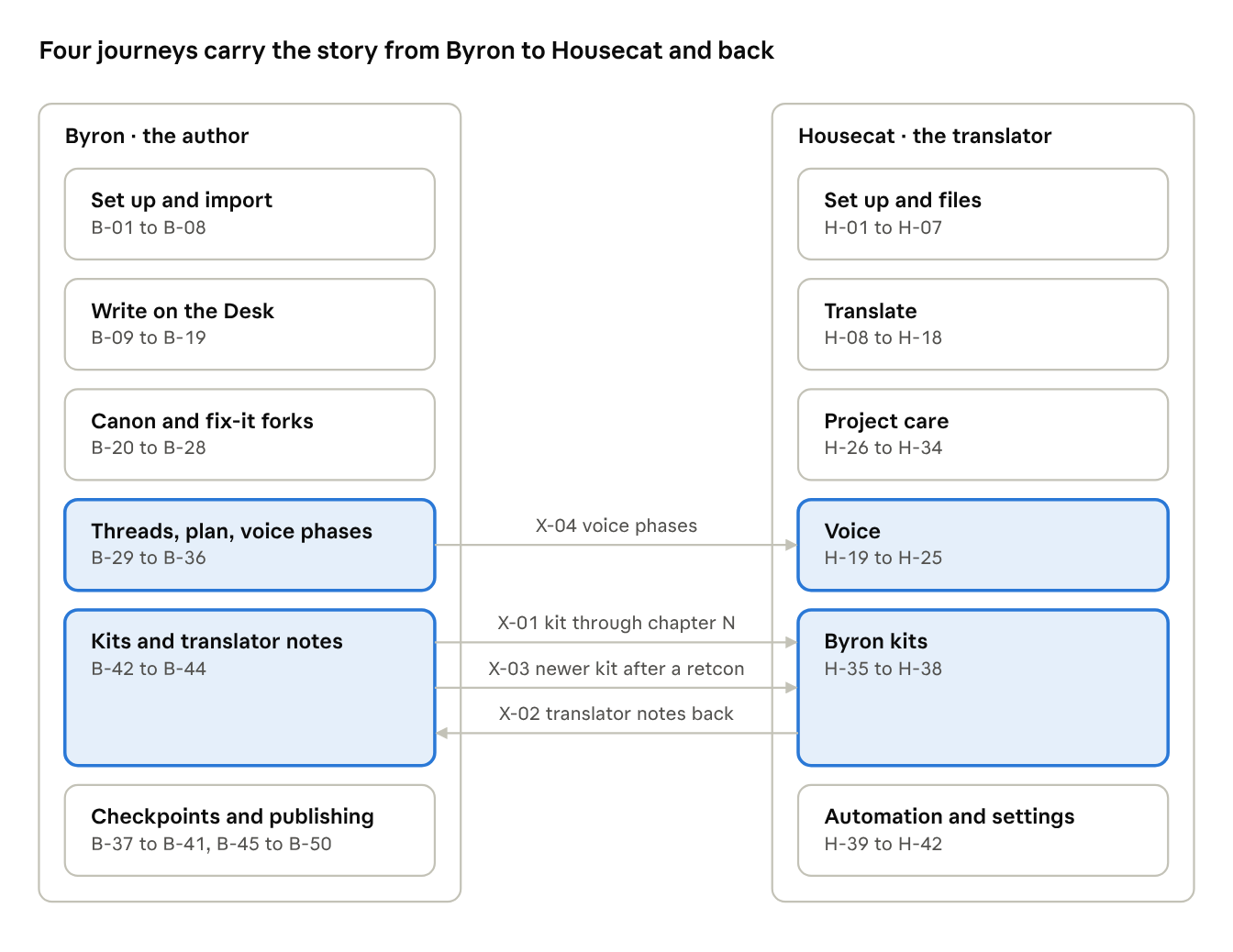
What crosses between them
Section titled “What crosses between them”- A kit, Byron to Housecat. The author exports a translator kit bounded at a chapter or scene. It holds only what a reader knows at that point: canon, a glossary (TBX), voice cards (SillyTavern V2), the chapters where each character’s voice changes, load-bearing markers, and the prose split into chunks with stable IDs. Notebooks, future canon and unaccepted facts never go in. X-01
- Notes, Housecat to Byron. The translator’s questions about facts or lines go back as one translator-returns file. Byron imports it once, shows each note against the current canon (verified, unverified, edited or missing), and never changes canon because of it. X-02
- A newer kit after a retcon. Byron compares kits; Housecat maps the changed facts to the segments already delivered, so the translator reviews only those. X-03
- Voice at every point. The kit carries voice phases as decided boundaries. Housecat never infers them from text, and scopes translation memory and MT examples to the speaker’s phase. X-04
Why time matters in both
Section titled “Why time matters in both”A character’s voice is a function of who they are and where they are in the story. A 100% translation-memory match from a character’s first phase is the wrong voice in her third. Likewise, a fact the author knows from chapter 1 may not be known to the reader until chapter 30. Both apps keep two clocks for that reason: when something becomes true, and when the reader learns it.
How they are built
Section titled “How they are built”Both apps are Rust with a Slint desktop UI on the shared jethaForge shell, moving off an earlier Tauri and React stack. Each keeps its logic in a core services crate that the desktop app, a CLI and an MCP server all call, so the three cannot drift apart.